Blog · Health & Wellness · Nov 7, 2026 (updated Nov 7, 2026) · CalorieAI Team · 7 min read
How to Track Calories Without an App (Scale, Paper or Spreadsheet)
Tracking calories without an app works with tools you already own: a kitchen scale, the nutrition label on the package, and somewhere to write things down, such as a notebook, a notes app or a spreadsheet. You note each food and its amount, look up the calories, and add them up once a day.
Maybe you're tired of apps that want a login, a subscription and your attention. Or you just like pen and paper. Either way, the methods below are older than any smartphone, and they still work if you know where they tend to break.
The two things every method needs
Whichever format you pick, two things do the real work. You need to know how much you ate, and you need a calorie number for that food.
For the amount, a simple digital kitchen scale beats guessing at home. For the number, you have two good free sources:
- The Nutrition Facts label on packaged food.
- USDA FoodData Central, the US Department of Agriculture's food composition database. It covers basic foods and branded products, and the data is in the public domain, so it costs nothing to use.
For everyday staples you can also check our own pages, for example calories in chicken breast or calories in oatmeal.
Reading the label without fooling yourself
Labels are easy to misread, and the mistake almost always makes a meal look lighter than it was. The FDA's guide to the Nutrition Facts label makes two points that matter most for counting.
First, every number on the label, calories included, refers to one serving. Second, the serving size is not a recommendation of how much to eat. If the bag says one serving and you ate two, the FDA's example is plain: you get twice the calories and nutrients.
So check the serving size before you check the calories. Then compare it with what's actually on your plate. Where the label lists the serving in grams, a scale settles the question in seconds.
A daily routine that keeps paper logging manageable
The format matters less than the habit. This routine works for a notebook, a notes app or a spreadsheet:
- Write it down when you eat it. Food, amount, and how it was cooked. Something like "2 eggs, fried in 1 tsp butter" is enough.
- Look up numbers later, in one batch. Leave a blank next to anything you don't know yet. Fill the gaps once in the evening.
- Keep a list of your regulars. Breakfasts and snacks tend to repeat. Write their calories on one page, or in a "foods" tab, so you only look each one up once.
- Total the day and move on. One number per day is all you need to compare against your target.
- Look at the weekly average. Single days swing around. The average shows whether you're in the range you planned.
If you don't have a target yet, How Many Calories Should I Eat a Day? walks through it.
Notebook, notes app or spreadsheet?
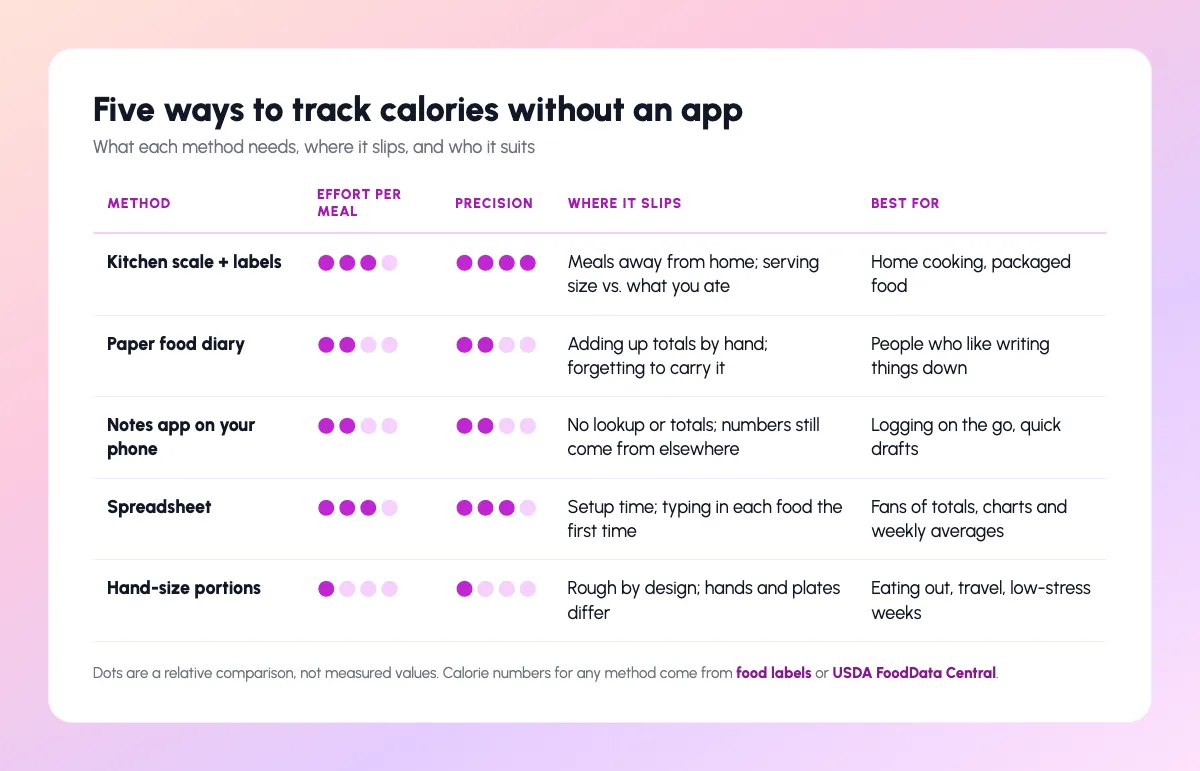
Each one has a different weak spot, and the graphic above sums them up.
A paper diary is the classic. A systematic review of self-monitoring in weight loss studies by Burke and colleagues (2011) found the paper diary was the method used most often, and it found a consistent link between self-monitoring and weight loss (the authors rate the evidence as weak because of study limitations). The downside is the maths. You add everything up yourself.
A notes app is always in your pocket, which helps with step 1. It has no food lookup and no totals, though, so the numbers still come from labels or the database.
A spreadsheet takes the most setup and pays it back over time. Give it columns for date, food, grams and calories per 100 g. If your source lists calories per 100 g, the formula is grams × calories per 100 g ÷ 100. Add a daily sum and a weekly average and you've built a basic tracker without installing anything.
Home cooking is where all three get tricky, because a pot of chili has no label. How to Calculate Calories in Homemade Food covers the recipe method step by step.
Estimating by hand when there's no scale
Sometimes there's no scale and no label. At a friend's place, at a work lunch, on holiday. A common rule of thumb uses your hand as the measuring cup: a palm-sized portion of protein, a fist of carbs like rice or pasta, a thumb of fats like oil, butter or nut butter.
It's rough. Hands differ, and so do plates. But a rough entry is better than a blank one, because skipped meals make your week look better than it was. For restaurant meals specifically, How to Track Calories When Eating Out has a faster approach.
Why manual logs tend to fizzle out
Paper logging rarely fails because people don't understand it. It fails because of time and friction.
A 2019 study by Harvey and colleagues gives a sense of the effort. Participants in a 24-week weight loss programme logged their food in a web-based tool. On average they spent 23.2 minutes per day on it in the first month and 14.6 minutes by month six. Those who lost at least 5% of their body weight opened their food journal more often each day (2.4 times versus 1.6). Keep in mind that this was a web tool that did the adding up, not a notebook.
The authors concluded that how often you log matters for weight loss, and that the time needed shrinks as you get practiced. That's encouraging. It also explains the drop-off: if every entry means finding the label, weighing and doing sums, logging three or four times a day starts to feel like homework.
A few things make manual tracking easier to stick with:
- Track the meals you're unsure about and keep the rest simple.
- Reuse your list of regular foods instead of looking things up again.
- Accept round numbers. "About 400" is a perfectly useful entry.
None of these methods is lab-precise, and neither is any app. Labels and database values are averages, and portions vary. Are Calorie Counting Apps Accurate? explains why consistency matters more than precision either way.
If the friction gets too much
Some people love their notebook for years. Others find that the writing and the sums are exactly what makes them stop. If that's you, the logging step can be shorter.
Calorie AI is one option. You say what you ate, for example "two fried eggs and a slice of toast with butter", and it estimates the calories and macros from that sentence. The estimates are approximate, like a hand-portion guess, but there's no lookup and no adding up. Whether you stay with paper or try something like that, the habit of noting what you eat, a few times a day, is what does the work.
FAQ
Can you count calories without an app?
Yes. Write down what you eat in a notebook, notes app or spreadsheet, take calorie values from food labels or the free USDA FoodData Central database, and add them up once a day. A kitchen scale makes the numbers more precise.
What is the most accurate way to track calories by hand?
Weighing food on a kitchen scale and using the label or a database value for that exact food. Remember that label calories refer to one serving, so if you eat two servings you double the numbers.
Why do people give up on paper food logs?
Mostly because of the effort: looking up every food, adding totals by hand, and remembering to write things down. Logging often during the day matters for results, so a method that feels like a chore tends to fade.
Read next