Blog · Health & Wellness · Nov 7, 2026 (updated Nov 7, 2026) · CalorieAI Team · 7 min read
Calorie Deficit Meals That Keep You Full (7 Examples, Added Up)
Calorie deficit meals are easier to stick with when each plate pairs a lean protein with plenty of low-calorie, water-rich food. Vegetables, fruit, potatoes and plain yogurt give you volume. Chicken, fish, eggs, tofu or Greek yogurt cover the protein. Below are seven example meals with their calories added up, ingredient by ingredient.
You've worked out your number, maybe 1,600 calories a day or maybe 2,000, and now comes the part that no calculator helps with. What goes on the plate so you're not hungry by 3 pm?
Every food value below comes from our own food pages, which use USDA data, and each ingredient links to its page so you can check the serving size yourself. If you still need a target, start with how to calculate your calorie deficit.
Why do some meals keep you full on fewer calories?
Three things do most of the work. None is magic.
Volume, or energy density. Energy density means calories per gram of food. Water has zero calories per gram, and fat has nine. A review by nutrition researcher Barbara Rolls (2017) explains that adding water-rich foods like vegetables or fruit lowers a meal's energy density. In the studies she reviews, people ate fewer calories without trying when their food was less energy-dense, and a large salad, soup or fruit as a first course reduced how much they ate overall. A systematic review for the US Dietary Guidelines found strong and consistent evidence in adults that eating patterns lower in energy density improve weight loss and maintenance.
Protein. A review on protein in weight loss by Leidy and colleagues found a modest satiety effect from higher-protein meals. People felt fuller, though they didn't eat less at the next meal. The authors suggest that at least about 25 to 30 g of protein per meal may help with appetite and weight management. Modest is the honest word. Protein helps, but it won't cancel out a 900-calorie plate.
Fibre. The NHS puts the target for adults at 30 g of fibre a day and notes that most adults eat about 20 g. Fruit, vegetables, oats, potatoes with skin and wholegrains help close that gap, and a medium apple alone brings about 4.4 g, a medium banana about 3 g.
Seven calorie deficit meal ideas, added up
These aren't a meal plan, just examples of how the numbers stack when you build a plate from standard servings. Cooking oil, sauces and dressings are left out on purpose, because they vary so much. More on that below.
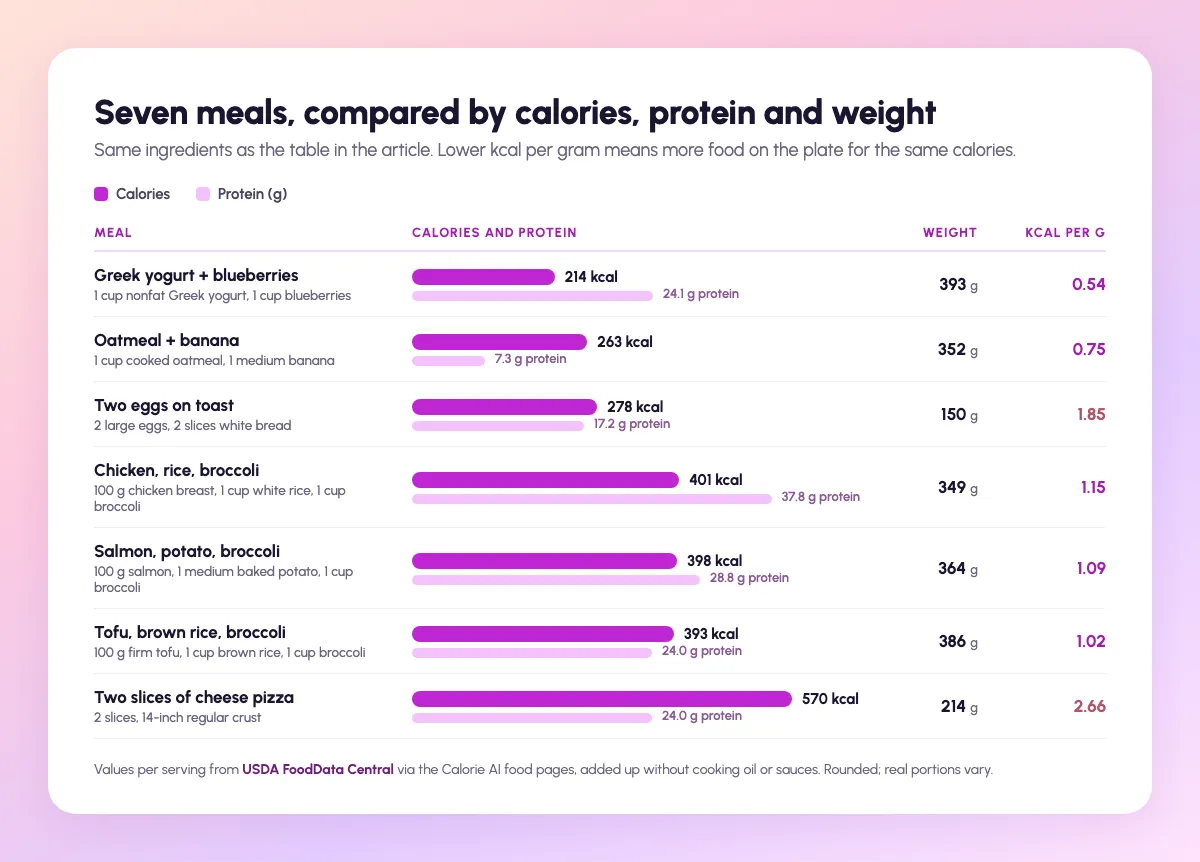
| Meal | Ingredients and calories | Total | Protein | Weight |
|---|---|---|---|---|
| Yogurt bowl | 1 cup nonfat Greek yogurt (130) + 1 cup blueberries (84) | 214 kcal | 24.1 g | 393 g |
| Oats and banana | 1 cup cooked oatmeal (158) + 1 medium banana (105) | 263 kcal | 7.3 g | 352 g |
| Eggs on toast | 2 large eggs (2 × 72) + 2 slices white bread (2 × 67) | 278 kcal | 17.2 g | 150 g |
| Chicken plate | 100 g cooked chicken breast (165) + 1 cup white rice (205) + 1 cup broccoli (31) | 401 kcal | 37.8 g | 349 g |
| Salmon plate | 100 g cooked salmon (206) + 1 medium baked potato (161) + 1 cup broccoli (31) | 398 kcal | 28.8 g | 364 g |
| Tofu bowl | 100 g firm tofu (144) + 1 cup brown rice (218) + 1 cup broccoli (31) | 393 kcal | 24.0 g | 386 g |
| Pizza, for comparison | 2 slices of regular-crust cheese pizza (2 × 285) | 570 kcal | 24.0 g | 214 g |
Take the chicken plate. 165 + 205 + 31 = 401 calories. Protein is 31 + 4.3 + 2.5 = 37.8 g. The weight is 100 + 158 + 91 = 349 g, which works out to about 1.15 calories per gram.
What the numbers show
Put the chicken plate next to two slices of pizza. The plate has 169 fewer calories, 13.8 g more protein and about 135 g more food on it. That's what low energy density looks like in practice. Pizza isn't banned, but it eats a big share of a daily budget, and the plate looks small for what it costs.
The oatmeal bowl is big and cheap at 263 calories, yet with 7.3 g of protein it falls well short of the 25 to 30 g range from the Leidy review. Swapping the banana for a cup of Greek yogurt would bring it to 288 calories and 29 g of protein (158 + 130 calories, 6 + 23 g protein).
Eggs on toast sits in the middle, and at 1.85 calories per gram it's compact, so it fills the plate less than the yogurt bowl does for about the same calories. Add fruit. A cup of broccoli works too.
The three dinner plates all land near 400 calories and differ mainly in protein, so if your daily target is around 1,600, three meals like these leave roughly 400 calories for snacks, drinks and cooking fat. Understanding macros goes deeper into how protein, carbs and fat share a day.
How to build your own deficit meal
The exact meals don't matter. The same pattern works with what's in your fridge.
- Set a rough budget per meal. Split your daily number into the meals you actually eat. Three meals and a snack is common, but two big meals work too.
- Start with protein. Pick a portion that gets you somewhere near 25 to 30 g, which in the table above means 100 g of chicken or salmon, or a cup of nonfat Greek yogurt plus a little extra.
- Fill half the plate with vegetables or fruit. They add weight and fibre for very few calories. A full cup of broccoli is 31 calories.
- Add a measured starch. Rice, potato, pasta, oats or bread. Use one cup or one medium potato as your unit, and weigh it the first few times.
- Count the fat last, and on purpose. Oil, butter, cheese, nuts and avocado make food taste good, and a small spoonful or handful of any of them carries more calories than a full cup of vegetables.
For recipes and batch cooking, how to calculate calories in homemade food shows how to split a pot into portions.
The calories that don't show up on the plate
Part of the gap between "I'm eating 1,600" and what the scale says often hides in small amounts of dense food. All of these are from our food pages:
| Extra | Serving | Calories |
|---|---|---|
| Olive oil | 1 tablespoon | 119 |
| Peanut butter | 2 tablespoons | 188 |
| Cheddar cheese | 1 oz (28 g) | 115 |
| Avocado | ½ medium | 160 |
| Almonds | 1 oz, about 23 nuts | 164 |
Cook the chicken plate in one tablespoon of oil and it becomes 401 + 119 = 520 calories. Stir two tablespoons of peanut butter into the oatmeal bowl and it goes from 263 to 451. Counted, that's fine. Left unlogged day after day, it quietly shrinks the deficit you planned. Calorie deficit but not losing weight? covers the other usual suspects.
Some cheap swaps from the same data: skim milk has about 83 calories per cup against 149 for whole milk, with the protein kept. Choosing a leaner ground beef over a fattier one also cuts calories per 100 g, as the ground beef page shows.
Keeping track without the homework
All of these numbers are averages. Your chicken breast may weigh 140 g, and your "cup" of rice may be generous. That's normal. What matters is logging your meals the same way every day, so the weekly total is roughly right.
If looking up every ingredient feels like too much, Calorie AI lets you say the meal in one sentence, like "100 g grilled chicken, a cup of rice and broccoli with a spoon of olive oil." It estimates calories and macros from that. The result is an estimate, not a lab value, so mention the oil and the portion size when you can. Either way, pick two or three meals from above that you like, keep them on repeat, and adjust the portions until the scale moves the way you planned.
FAQ
What should I eat in a calorie deficit?
Meals built around a lean protein source plus plenty of vegetables or fruit, with a moderate portion of starch. Water-rich foods add volume for few calories, and protein adds a modest boost to fullness.
How many calories should a meal be in a calorie deficit?
It depends on your daily target. Many people split it into three meals and a snack. On a 1,600-calorie day, that could be three meals of around 400 calories and a 400-calorie buffer for snacks, drinks and oil.
Which foods make a calorie deficit easier?
Foods with few calories per gram, such as vegetables, fruit, plain Greek yogurt, potatoes and lean protein. Calorie-dense extras like oil, nut butter, cheese and nuts are fine in measured amounts but add up fast.
Read next